Data centers are the fastest-growing segment of commercial construction and one of the most demanding environments for precast detailing. Aggressive schedules, dense MEP coordination, and mission-critical precision requirements mean there is no room for errors, delays, or rework. EDGE^R is built to handle all of it.
The numbers behind the data center boom are hard to ignore. Hyperscale cloud providers, colocation operators, and enterprise IT tenants are all racing to add capacity and precast concrete is winning an outsized share of that construction volume. The reasons are familiar: speed, quality control, durability, and the ability to deliver large structural packages on compressed timelines that cast-in-place construction simply cannot match.
Precast producers like Metromont and Wells are already deep in this market, delivering hollow-core floor systems, load-bearing wall panels, and structural framing for data center campuses across the country. The structural precast package on a hyperscale facility can top 500 pieces, all of them needing complete shop drawings, coordinated connection details, and a production schedule tied to a delivery sequence the GC will not negotiate.
Why precast wins data centers and why detailing is the hard part
Precast’s value proposition in data center construction comes down to three things: schedule compression, quality consistency, and the ability to pre-install embed hardware with a precision that field crews cannot replicate. A precast wall panel arrives on site with every anchor, embed plate, and conduit sleeve already cast in and positioned to within a fraction of an inch of where the structural drawings say it needs to be.
That precision starts in the detailing office, months before the first panel leaves the plant. Every embed location, every opening, every connection has to be detailed correctly before production begins. On a data center project, where MEP systems are dense and the mechanical, electrical, and plumbing trades are all working to tight equipment clearances, the coordination burden on the detailing team is substantial.
Simply throwing more detailers and more hours at the project does not scale with the pace of the market. EDGE^R does.
"Data center owners don't give schedule extensions. The fabricator who can detail faster, coordinate tighter, and release cleaner wins the work — and keeps it."
The precast piece types EDGE^R details for data centers
A full precast data center package touches nearly every piece type in the fabricator’s repertoire. Here is how EDGE^R handles the key elements.
The backbone of data center raised floor systems. EDGE^R manages the dense field of mechanical and electrical penetrations — conduit sleeves, cable tray openings, and equipment pad blockouts — while maintaining structural integrity across every span.
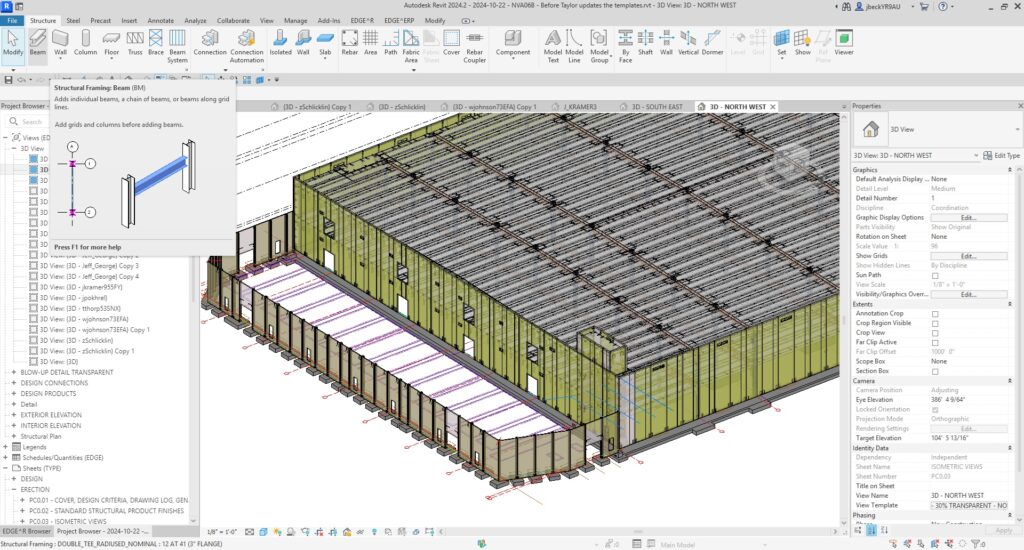
Precast wall panels form the primary enclosure of most hyperscale data centers. EDGE^R details panel dimensions, embed plate layouts, and the precise joint conditions that support both structural performance and continuous air and vapor barriers.
Used for long-span roof framing on large data center halls, double tees must accommodate heavy mechanical loads from rooftop cooling units. EDGE^R manages camber, insert spacing, and embed hardware required for MEP attachments above and below.
The structural grid of a data center is unforgiving — column bays are sized to maximize raised-floor efficiency, and spandrel geometry must accommodate cable entry points at the facade. EDGE^R coordinates both with the wall panel system.
Interior framing that creates the clear spans data centers need. Ledge geometry and bearing conditions are managed parametrically, so changes to bay dimensions propagate through the entire framing model without manual rework.
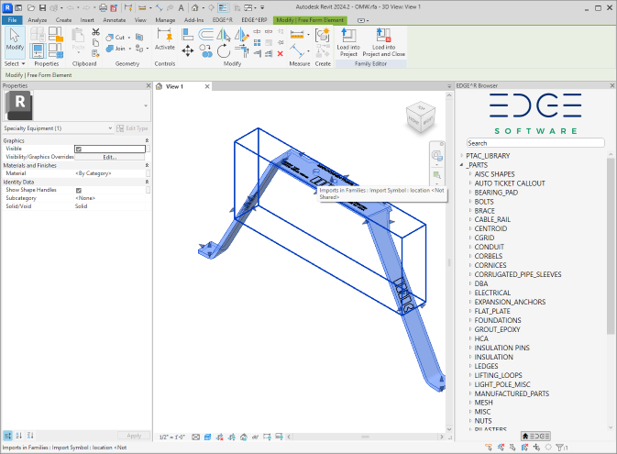
Critical infrastructure pads for backup generators and transformer vaults require precise embed patterns, housekeeping pad geometry, and clearance coordination with structural elements. EDGE^R models these as integrated precast assemblies.
Precast stair and egress tower assemblies in data centers must meet strict fire-rated construction requirements. EDGE^R details the full stair assembly including flights, landings, and wall panel integration.
Generator yards, cooling tower enclosures, and secure perimeter walls are often precast. EDGE^R handles the structural detailing of these site elements in coordination with the primary building model.
Clash detection: catching MEP conflicts before they reach the field
Data centers carry more mechanical, electrical, and plumbing density than almost any other building type. Overhead cable trays, conduit runs, cooling pipe distribution, and generator exhaust routing all have to coexist with the precast structural assembly. Data center precast must accommodate larger clearances in shafts, ceiling spaces, plenums, and chases for HVAC infrastructure, as well as accessible raised floors. Every one of those conditions creates potential conflict geometry between the precast structure and the systems passing through it.
A conduit that cuts through the wrong flange of a hollow-core slab, or a pipe that conflicts with a corbel on an inverted tee, does not get discovered until the erection crew hits it. At that point, the fix is expensive, the schedule is at risk, and someone is writing an RFI.
EDGE^R addresses this with built-in clash detection for precast assemblies. Before a shop drawing is released for production, the EDGE^R model can be checked against the MEP model to identify conflicts between the precast structure and the systems running through and around it. Clashes surface in the model rather than in the field.
For data center projects, that capability is a requirement. The MEP systems in a hyperscale facility are engineered to tight tolerances, procured on long lead times, and often installed on a sequence that is locked before the precast erection is complete. A conflict discovered after production means a modified piece, a delayed pour, or a field modification that no one budgeted for.
EDGE^R’s clash detection closes that gap at the detailing stage, where the cost of a fix is a model edit rather than a concrete saw or a repour.
Metromont
Engages early through design-assist to ensure flexibility throughout the design process, makes critical path material purchases to insulate against supply chain disruption, and runs multiple crews and shifts with onsite staging to meet hyper-fast schedules.
Wells
Leverages precast's solid mass and structural flexibility to meet data center-specific demands — vibration resistance for sensitive equipment, clean-room panel finishes with no microscopic voids, four-hour fire ratings, and proven seismic connection technology deployable in any zone.
Both producers depend on accurate, clash-free shop drawings released on time. That starts with EDGE^R.
Detailing at data center speed
Data center owners talk about speed differently than other clients. An 18-month delivery target for a hyperscale campus is often a contractual obligation tied to a cloud provider’s capacity commitments. Missing it has real financial consequences for everyone in the supply chain. Metromont’s approach illustrates what it takes on the production side: early design-assist engagement, critical path material purchases to get ahead of supply chain risk, and onsite staging with multiple crews and shifts to support as-needed delivery and installation.
All of that production infrastructure depends the shop drawings being correct, complete, and released on time. A design-assist engagement that starts early only pays off if the detailing team can keep pace with a design that is still evolving. Critical path material purchases only protect the schedule if the piece dimensions and embed layouts are locked when the order is placed. Onsite staging only works if the pieces arrive clash-free and ready to set.
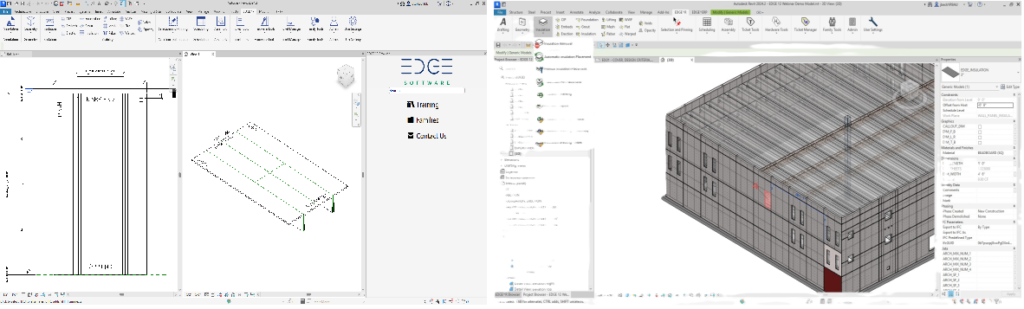
EDGE^R is what makes the detailing side of that equation work. Parametric piece families absorb design changes without cascading rework. Revision cycles that once took days are handled in hours. The model stays coordinated with erection drawings and production schedules from the first release through the last piece.
Resilience by design and detail
Data centers have structural requirements that go beyond a standard commercial building. Blast resistance, progressive collapse mitigation, and enhanced seismic performance are common in mission-critical facility specifications. Precast concrete systems, using proven connection technology, can be deployed in all seismic zones. Precast’s inherently noncombustible composition, combined with compartmentalization design, can contain accidents to specific areas.
These requirements translate directly into connection details such as more reinforcement, more complex embed geometry, and closer coordination with the structural engineer of record. EDGE^R’s connection library and vast tool set are built to handle that complexity. Custom connection families can be defined to match project-specific structural requirements, and those families propagate consistently across every instance in the model. When the structural engineer requires a heavier corbel or a revised embed plate pattern for blast resistance, the change is made once and applied everywhere it is needed and instantly hundreds of individual shop drawings can be updated and ready to release.
The bottom line for fabricators targeting data center work
The AI infrastructure buildout, cloud capacity expansion, and enterprise colocation demand that are driving the current wave of data center projects are likely to continue for the next few years. For precast fabricators, this is a generational market opportunity for those who can detail and produce at the speed and precision the market demands.
See how EDGE^R's parametric detailing environment handles the speed, precision, and coordination demands of hyperscale construction.
Request a Demo