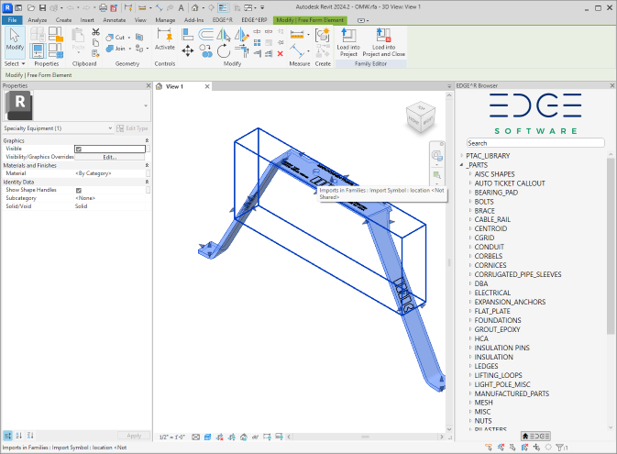
If there is one building type that puts precast detailing to the test, it is the parking structure. High piece counts, aggressive schedules, repetitive but never truly identical geometry, and owners who want every stall delivered on time and under budget. EDGE^R was built for exactly this kind of pressure.
Drive past any mixed-use development, hospital campus, airport, or urban core and you will likely see a plethora of parking structures . Precast concrete is the material of choice for parking garages because it delivers speed, durability, fire resistance, and the long clear spans that drivers and operators demand. All of that efficiency in the field starts with accurate, complete detailing in the office.
The detailing challenge in a parking structure
A mid-sized urban parking garage might contain several hundred double tees, dozens of spandrel beams and columns, multiple stair and elevator tower assemblies, and a full complement of connection hardware, such as corbels, embed plates, bearing pads, field-welded connections, and more.
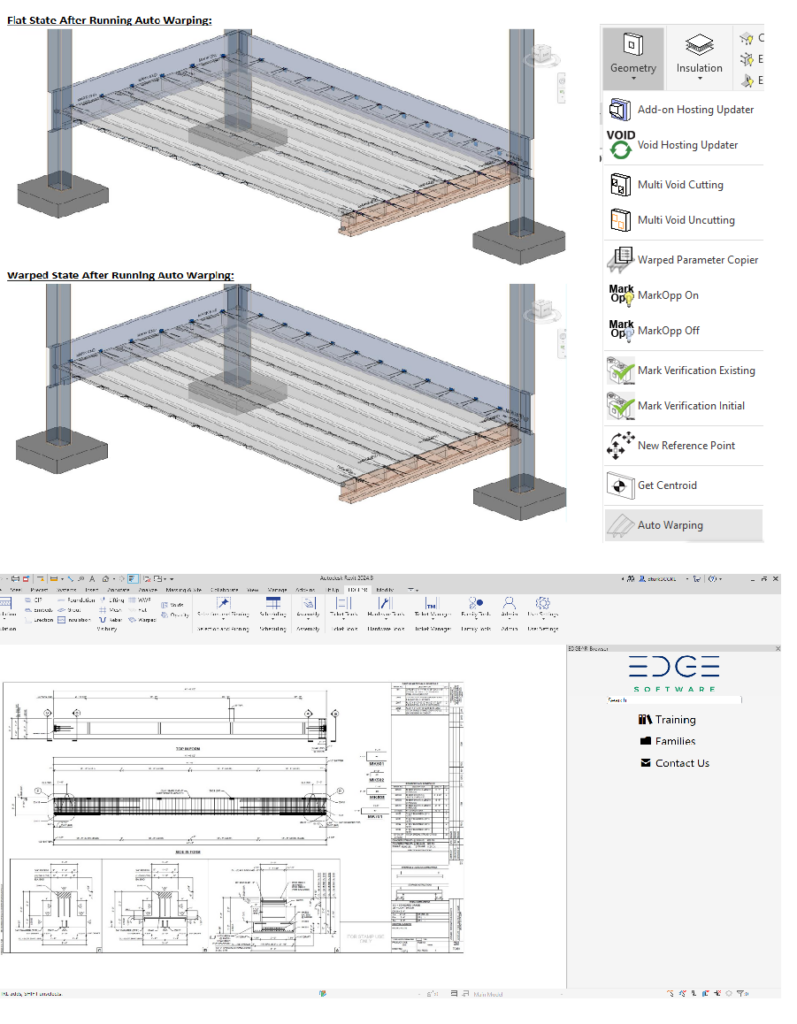
Each of those pieces needs a complete shop drawing. Each connection detail needs to be coordinated with the structural engineer of record. Each piece needs to be scheduled, sequenced, and tracked from pour to erection.
Now multiply that by the reality that no two parking structures are exactly alike. Column bays shift. Ramp geometries vary. Facade treatments change from level to level. What looks repetitive from the outside is full of variation on the inside — and traditional detailing workflows feel every one of those variations as manual rework.
"What looks repetitive from the outside is full of variation on the inside — and traditional workflows feel every one of those variations as manual rework."
EDGE^R addresses this directly. Its parametric modeling environment is designed around the way precast fabricators actually think about a job: by piece type, by bay, by erection sequence. Changes propagate. Schedules update. Details stay coordinated. The model is the single source of truth from contract award through final release.
The precast piece types EDGE^R handles in a parking structure
The primary floor and roof framing element. EDGE^R manages span-by-span variation in section depth, camber requirements, topping thickness, and flange pour strips — plus all embedded hardware for connections and traffic coatings.
Perimeter framing that does double duty as structure and facade. Spandrels carry eccentric loads from double tees and often feature architectural reveals, rustication, or integrated drainage. EDGE^R handles the full connection geometry at both ends.
Interior framing that supports double tees on both ledges. Ledge geometry, bearing lengths, and dapped end conditions are all managed parametrically — critical for avoiding field fit-up problems.
Precast columns in parking structures typically run multiple stories and require careful attention to corbel sizing, embed locations, and base plate conditions. EDGE^R coordinates column details with the beam and tee framing above and below.
Lateral load resistance in precast parking structures is often provided by precast shear wall panels. EDGE^R details panel dimensions, connection hardware, and the critical joint conditions between panels and the foundation.
Precast stair flights and landing slabs are standard in parking structures. EDGE^R handles the stringer geometry, tread and riser dimensions, bearing conditions, and integration with the surrounding structural frame.
Sloped ramp elements introduce compound geometry that trips up generic modeling tools. EDGE^R manages the slope, camber interaction, and edge conditions of ramp slabs as a first-class piece type.
Non-loadbearing facade panels, screen walls, and parapet panels complete the enclosure. EDGE^R coordinates panel dimensions and anchor locations with the structural frame to eliminate RFIs at the facade-structure interface.
Why repetition is both the opportunity and the trap
The appeal of parking structure detailing is that so much of it looks the same. The same double tee section repeats across dozens of bays. The same column detail appears at every gridline. If you can get the first one right, the rest should follow automatically.
The trap is that “mostly the same” is not the same as “identical.” Bay widths shift at ramps. Column spacing changes at stair towers. Edge conditions vary at every facade. In a tool without true parametric intelligence, each of those variations requires a manual edit, which leaves room for errors.
EDGE^R is built around the premise that precast detailing is inherently parametric. Piece families are defined by rules, not by individual instances. When a bay width changes, every piece in that bay updates. When a bearing condition is revised by the engineer, every affected shop drawing reflects the change. The model stays coherent even as the project evolves.
Coordination that keeps the erection crew moving
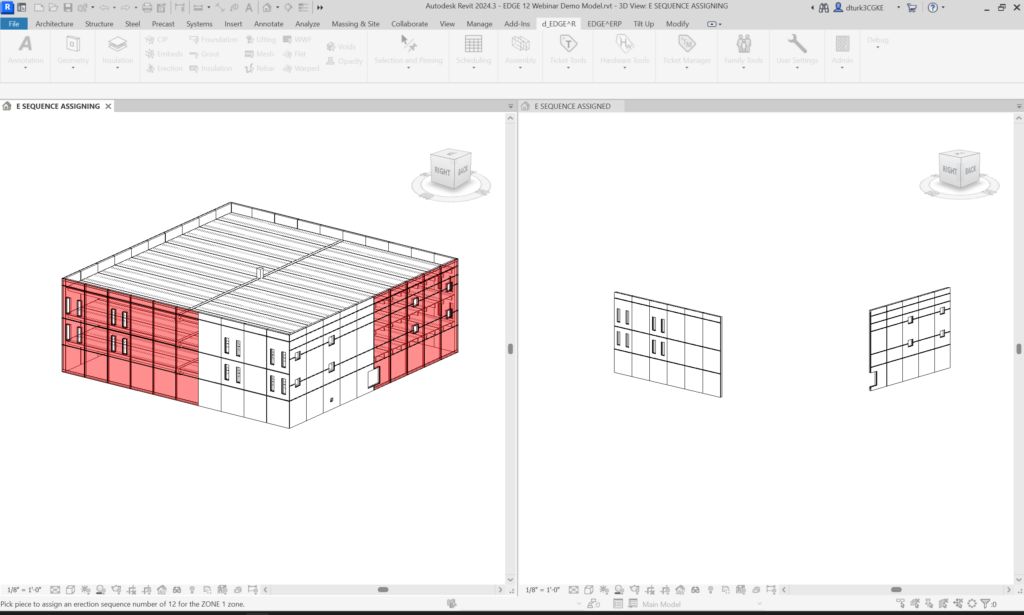
Precast erection is expensive. Cranes do not wait. Every piece that arrives on site needs to be the right piece, in the right sequence, with all hardware in the right location. That level of precision does not happen by accident — it is the product of detailing done right months earlier.
EDGE^R supports the full coordination workflow that parking structure projects demand: piece marks that tie directly to the erection drawings, schedules that update as pieces are released for production, and a model that the erection crew can reference in the field. When the GC asks for a revised sequence because a concrete slab pour is running late, the answer is a model update — not a manual redraw of half the erection set.
The bottom line for precast fabricators
Parking structures are a core market for precast fabricators, and winning them consistently means being able to detail them efficiently, accurately, and with enough flexibility to absorb the changes that every project brings. EDGE^R gives detailing teams the tools to do exactly that by handling the full range of piece types, managing the inherent variation within a “repetitive” building, and keeping the model coordinated from the first column to the last double tee.
The next time a parking structure RFP lands on your desk, the question is not whether your team can detail it. The question is how fast you can get it done with minimal errors. EDGE^R makes that process a lot easier.
Ready to bring EDGE^R's parametric detailing to your next parking structure project? Let's talk.
Request a Demo